Hi Everyone,
For the latest on Life in China, pop over and check out our series on http://www.ourtravelingzoo.com, or click this link.
At this point, there are six entries, including ones on cost of living and shopping in Hong Kong.
See you there!
Hi Everyone,
For the latest on Life in China, pop over and check out our series on http://www.ourtravelingzoo.com, or click this link.
At this point, there are six entries, including ones on cost of living and shopping in Hong Kong.
See you there!
Hello Everyone!
I haven’t logged into Vantage Points in a couple of months, and man, it’s fun to figuratively see all the familiar faces! You all have such cool blogs.
Anyway, I wanted to ask if you’ve checked out our new site yet.
So, have you?
We’re working on great new content about living and working in Shenzhen, China, and also about our ongoing travel adventures with the little ones. Stop by and say hello! Also, it’d really make our day if you signed up for our newsletter when you drop in so we can stay in touch.
Here’s the link: http://www.ourtravelingzoo.com
Hope to see you soon!
Shon
Jenia and I wrote a post about one of our favorite things in Singapore (at the Singapore Zoo, actually)! It’s on Our Traveling Zoo. Have a look and give us your feedback! Oh, and go eat with an orangutan when you can!
Jenia and I have decided to make the leap, after five years and almost 100,000 views here, to our own site with our own domain name.
Please check out our brand new (far fancier!) website called Our Traveling Zoo. There we are continuing to write about life abroad: traveling (with toddlers!), teaching, and whatever else arises of interest, but in a more focused fashion. We’re migrating some of our content from this page to Our Traveling Zoo and revising it slightly to make it better and better, so if you’re looking for a post and can’t find it, check the new site.
Of course, please get in touch with us if you have any questions!

Our Traveling Zoo captured somewhere in the USA!
It’s been long enough that we are through the honeymoon phase of our move. We should be thoroughly into the “hating it all” phase, but remarkably, we’re fairly content. A few months time living in Shenzhen has given us a bit of perspective, and we’ve seen much of the city now (but not all of it by any means). We still find the generous greenery appealing. We still can’t believe there aren’t a million traffic fatalities every day. We have learned more about the city, and made more observations. Here are some.
Population: almost 12,000,000. Some estimates place the actual population, including those who aren’t registered officially, closer to 17,000,000. It’s China’s fourth most populous city, behind Guangzhou, Beijing, and Shanghai. I figure it’s part of the reason traffic laws and crosswalks aren’t necessarily paid much heed to, but that maybe just because the cops in the vicinity don’t care much. I hear other districts have more rigid policing. Anyway, since Shenzhen is such a big city, it takes a long time to get around. Speaking of getting around…
Didi: it’s Uber, but bought out by a Chinese company. With a new English interface, Didi makes hailing a ride much easier. I set it up, in conjunction with the ubiquitous social app WeChat, so that our rides are automatically debited from my bank account. This leads us to…
WeChat: it’s China’s do-all social app, and it’s mind-blowingly convenient. I can scan a QR code to pay for food, taxis, bicycle rentals (something else very China), and the like, after linking my bank account. I can use it like Facebook or like Facebook Messenger. It’s a bit like Apple Pay meets Facebook and they have a baby. A really convenient baby. Now, back to observations–a drive, or indeed a Sunday afternoon stroll, could not be accomplished without witnessing…
Skyscrapers: lots of them! The Ping An International Finance center, designed by an American firm, was just finished this year, and it is the fourth tallest building in the world. There are high-rise apartments everywhere. Quality, if you’re wondering, doesn’t seem to be especially high in most buildings, though they are evidently safe enough. Speaking of super tall buildings, presently, according to CNN, there are 49 buildings over 200 meters tall in Shenzhen.
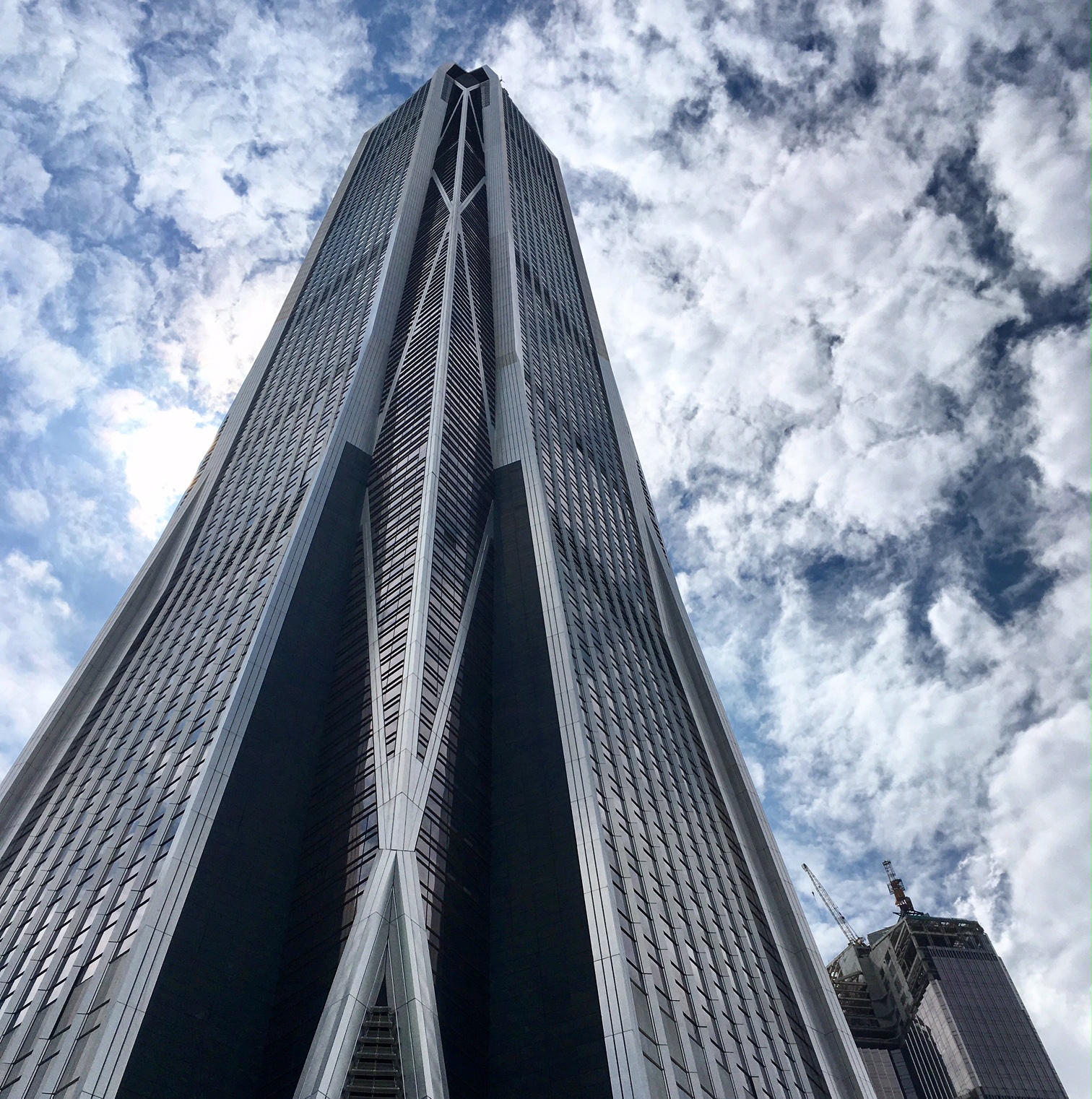
Newly completed, Ping An International Finance Center reaches 599 meters into the sky, making it the world’s fourth tallest building. It comes within about 10 meters of being the third tallest and is indeed impressive.
Style: still not much. On hot days, of which there are many, men roll up their shirts to keep their navels cool. As I mentioned in an earlier post, my coworkers christened this the “Beijing Bikini,” while I just call it cringe-worthy. Other men shirk the shirts altogether, regardless of whether or not they have a body worth showing off. One must admire the unselfconsciousness of these guys, I guess. When it’s hot, you gotta be comfortable, right? To answer your unspoken question, not everybody disregards all sense of taste. There are definitely some elegant dresses and spectacular suits, but they’re in the considerable minority.
T-shirts: we get quite a kick out of seeing things terribly written in English (and sometimes terrible things written in English) on T-shirts here. Check out the hilarious (and highly inappropriate) things people wear courtesy of an instagrammer from Shanghai, who’s made an effort to document some of the ridiculousness here, if you dare. We’ve seen some pretty dumb shirts, but nothing quite the jaw-dropper “I Am a Whore” is, for example. Now, let’s move onto that favored, always-safe conversational topic: weather.
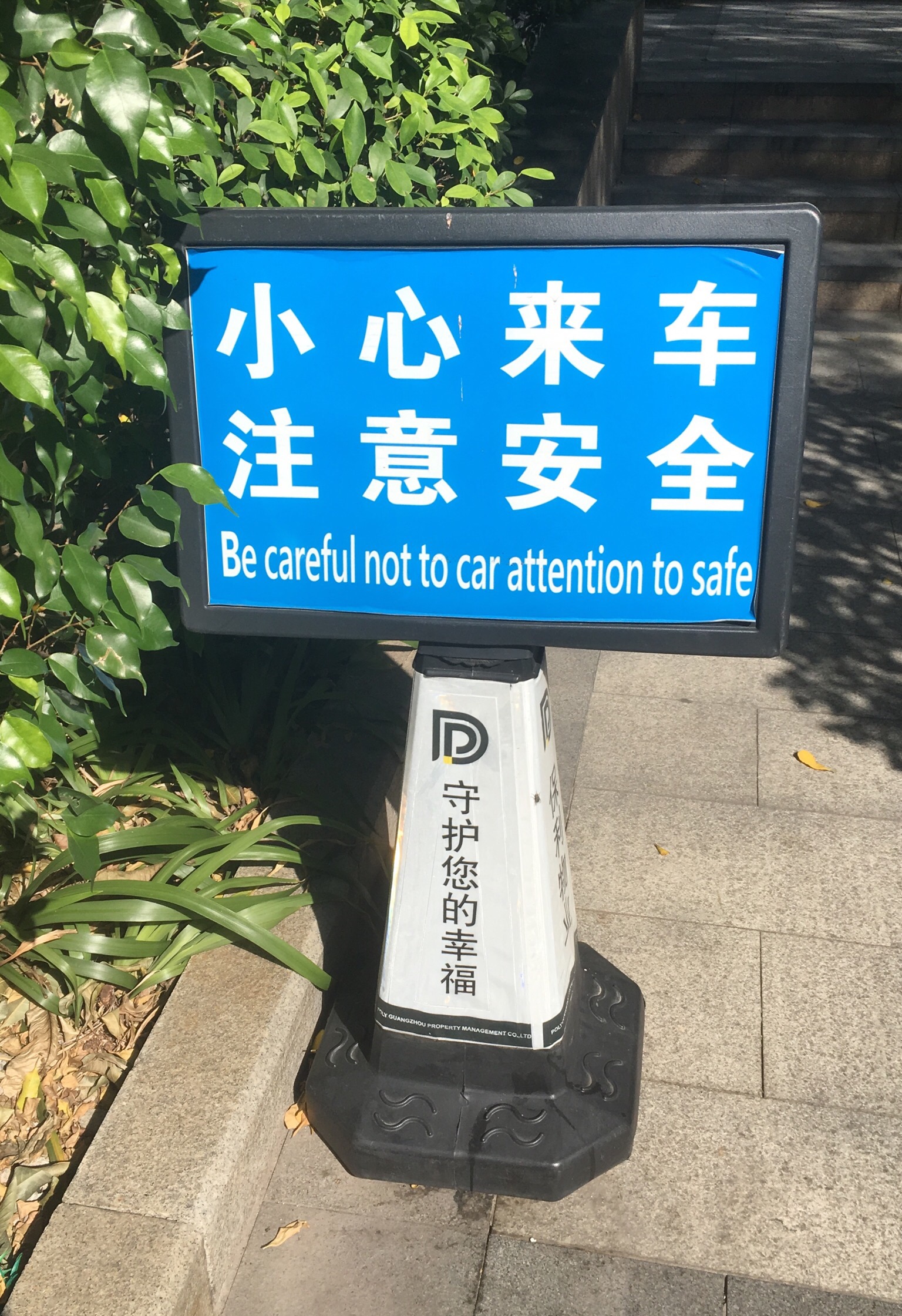
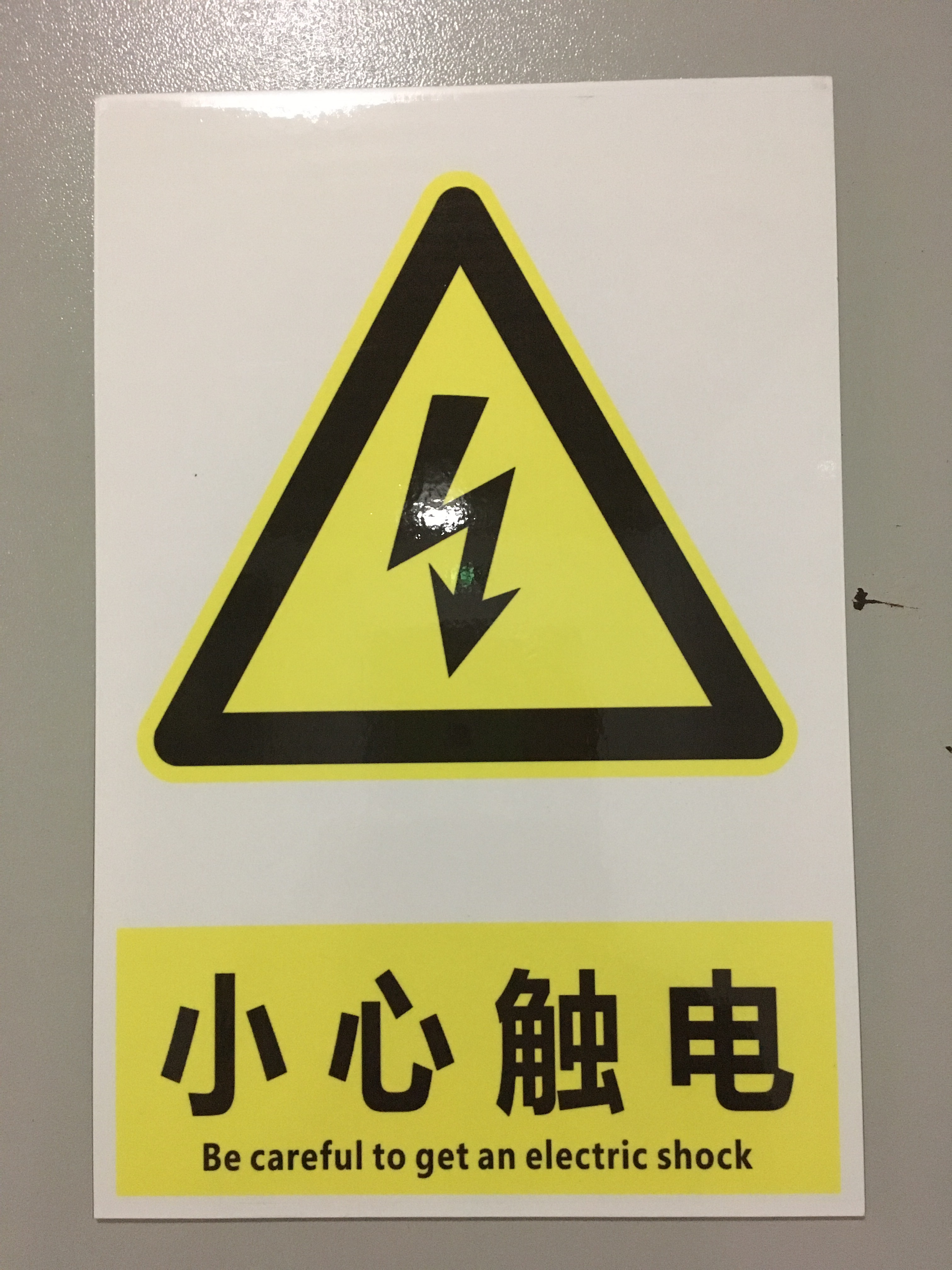
T-shirts aren’t the only things to get puzzling or hilarious English translations, as these signs attest.
Temperature: has now dipped into the upper 50’s (Fahrenheit) at night. It feels like fall at last. Today Jenia even lamented not having brought more cold-weather clothing from the States. Shenzhen veterans tell me temps can dip almost to freezing, and when that happens, it’s mighty unpleasant, for there isn’t any heating inside the school offices. With the mercury dropping, it actually seems appropriate that we should be having…
Thanksgiving: not celebrated by Chinese folks, of course, so Starbucks is already decked out for Christmas. As for us, we will be celebrating over the weekend with friends–folks we know from the UAE, as well as new ones we’ve met on this teaching adventure. One of the enduring pleasures of life abroad is the relationships that spring up and the surrogate families that form.
Big city life is noisy, right? So is country life, but in its own way, you might say. And you’d be right. I never knew how many weird noises cows make before moving to rural Georgia, after all. Big city noises are different, though. The unceasing clatter and din of human beasts. Traffic. Construction. Demolition. Reconstruction. Jackhammers.
In Shenzhen, there’s hardly a day goes by without the obnoxious racket of a jackhammer. There is a construction site adjacent to our residence–everyday for months they’ve been excavating there, cutting and drilling and slamming out rock so they can erect another skyscraper. Are you familiar with that process? Huge hydraulic breakers are employed to do the job, mounted on large crawler tractors. They repeatedly send a heavy chisel point into the rock. Eventually an excavator comes along and digs out the debris, whereupon a dump truck hauls it off. As you can imagine, it’s a loud and drawn out process.
Last week, a crew started demolishing the vacant Longzhu Hospital which is just across the road on the other side of our domicile. Now the clamor of jackhammers and breakers echoes off Tanglang Mountain from that direction, too.

There’s no relaxing outside in the beautiful fall weather because it’s so loud all the time. Even relaxing on the balcony is unrealistic. Luckily, after 6:30pm all is quiet.
Unless, that is, the road is being torn up so a sewage line can be replaced. Or they’re paving the other road.
Bearing all this in mind, when Jenia and I spent the night at the fantastic new Hard Rock Hotel in Longhua, some 45-60 minutes away, I was delighted that it was located in Mission Hills, where a posh golf course exists, and where things must surely be quieter.
Imagine my dismay when I was awakened on the 15th floor by the noise of what appears to be a metro line under construction. The entire median separating the highway was a big work zone. Curses.

But that’s all part of the deal with Shenzhen. It is a really big city, after all. Much of the construction really does make life better, ultimately, but it’s a drawback to living here as well.
As we’ve rhapsodized about before, we love having friends the world over as a result of living and working abroad. Last week was one of China’s Golden Week holidays–a time when holidays coincide to allow an entire week off from work. We called up a friend (okay, we didn’t even do that, we just used Facebook messenger to get in touch) who lives in Hong Kong, a mere 30 miles away. This is a pal we met while working in Russia. She now resides in Hong Kong, and it seemed like the Golden Week might allow us the chance to get together. As it happened, though, she already had travel plans. So when she went on vacation to Japan, she set us up for the week in her lovely studio apartment.
This meant we had a chance to explore Asia’s world city in a whole different manner than we’d have done if we stayed in a hotel.
Here’s the funny thing–after a week there, neither of us were blown away. We’d expected a place significantly different from Shenzhen. Don’t get me wrong; in Hong Kong you’re less likely to see a toddler popping a squat beside the road, but I did witness a kid taking a leak into a bottle his mom was holding while we visited a children’s science museum. There are signs posted all over the city forbidding spitting and littering, as well as stipulating mandatory fines for those behaviors. Indeed, before arriving in China, I’d heard horror stories about mainland Chinese people constantly spitting everywhere–and that maybe true of second tier cities, but I’ve only seen a few people hock up loogies during the seven weeks I’ve been in Shenzhen. That’s not to say it doesn’t happen, but it’s not a big problem I’ve encountered. Now, was HK cleaner? Maybe somewhat, but there was still plenty of grunge. In actuality, there are parts of Shenzhen which are cleaner (as well as dirtier, to be fair). Shenzhen shines in some respects, and even compares well to its much more famous neighbor. Let’s take the subway system, for example. SZ’s is nicer–cleaner, larger, better illuminated. While HK has a truly admirable network of public transportation, the electric buses in SZ are much quieter and represent a significant contribution to Shenzhen’s urban environment.
One of our friends here described Hong Kong as “China with a veneer of money,” if I recall his turn of phrase correctly. That’s accurate, although not everyplace in HK is wealthy. Regardless, HK represents a more picturesque place to spend time in than Shenzhen, with stunning cityscapes visible from Victoria Peak and Victoria Harbor.
It’s a big city, so there’s a ton of people. And with tons of people come huge crowds. Sometimes I wanted nothing more than to get away from the crowds. But then, that’s the same in Shenzhen. Now and again, popular places just get too packed for comfort.
We made a day trip to Repulse Bay, and found ourselves on a nice beach with pleasant scenery. It was relatively uncrowded, although there were bunches of people, often Filipinas enjoying themselves very loudly, occupying all the patches of shade. That was fine with us, as getting some sun is part of the reason we like going to the beach, but getting a tan is anathema to most folks occupying this neck of the woods. It was interesting watching the people and groups. There was a church conducting baptisms and singing praise and worship tunes. There was a 60 year old American man and his brother with a gorgeous 25 year old woman of Asian lineage (she was probably American, too, going by her accent) popping the cork out of a bottle of champagne. There were myriad women dressed up and striking poses while their spouses or friends snapped pictures, each doing their best to look like a model. And it must be said, the water was perfect for swimming.
During our days exploring via the cheap and fabulous Star Ferry, the famously creaky double decker trams, and also on buses and our own feet, we covered quite a bit of territory. For the most part, we took in all the touristy things on Hong Kong Island and Kowloon, while skipping Lantau Island, since we can get there easily enough another time. One day we walked more than 7 miles, and others we covered 5 plus. That was tiring, since Hong Kong Island is something like San Francisco in the sense that it is very hilly. In fact, there are even a series of outdoor escalators to help make life easier. The sidewalks are also there one minute, and all but gone another, depending on where you happen to wander, which makes life interesting.
Some things we enjoyed seeing included Hong Kong Park, nearby the hugely popular Victoria Peak Tram (pro tip–go before 9:00 am), and the Zoological Park, which had a lot of monkeys who were very animated–except the humongous orangutans, who were more interested in lounging around with head coverings they’d fashioned from leaves than anything else. We found some of the temples, including Man Mo (which is in the process of being refurbished, by the way) interesting. Man Mo, for example, is named for two gods–the god of literature and the god of war. The customs observed by worshippers inside are very similar to those we observed when we visited a local Buddhist temple in Shenzhen (incense being burned, respect being paid, food and drink sacrifices being offered).
Here’s something we learned about traveling to HK from SZ–it’s necessary to fill out an immigration card when leaving China (yes, HK is part of China, but it’s treated as if it isn’t), and there weren’t any signs or forms to indicate that. So if you’re waiting in line to leave China and there aren’t any immigration forms at hand, go to an immigration officer and get some. It’ll save 10 or 15 minutes and the necessity to step out of the queue, because they want the forms all filled out before you get to the desk. Hong Kong wants forms, too, and they give you a little 1-inch square piece of paper with a stamp on it you’ve got to keep, too, so that’s a slight annoyance, ’cause man, it’d be easy to lose.
Make friends, visit them, or at least visit their apartments. Build some good relationships with fine people and enjoy their hospitality when the opportunity arises. It is something which helps develop and expand horizons, and it also can provide entirely new options for exploring the world.
In lieu of a straightforward narrative per the usual, here’s a post that aims simply to catch the feelings of some recent moments. Some paragraphs are present tense, some past, so don’t get all English teachery about it. It’s about emotion.
Dafeng Oil Painting Village: Man, most of these rip-offs/copies of other people’s work are actually not even good. Low-caliber. Also, this whole street reeks of sewage. But where are the bathrooms? This toddler needs to pee! No luck with a bathroom. A while later: look, there’s a local mom holding her son in the air, buck naked, over a diaper so he can do his business (again, judging by the state of the diaper).

Princess doesn’t care that this is a low-caliber knock off. She likes it.
Walmart: no thanks. Holy too-packed-for-me, Batman!
Electric buses used everywhere in SZ for public transportation are made by BYD (who has a factory in California now). Slick! Quiet, modern, nice. The buses also have English announcements, making using them painless for foreigners like us.
More cloudy days than not. Glimpses of blue skies and rare clear days. I’m enjoying one of these on my balcony now, sweating like a stuck pig, but thrilled with the sun beaming down on me.
Clouds keep the heat down.
Buddhist (i.e. Vegetarian) restaurants and Muslim (i.e. halal) noodle places. Who knew?
Curse those wretched silent electric bikes which disregard all rules. Sidewalks, opposite traffic lanes, you name it, they go there. Royally irritating. Can’t let your guard down while walking, and especially not with little ones.
Curse also the miserable excuse for a human who decided to start putting durian into all manner of otherwise delectable foods. Breads, ice creams, you name it. If it’s yellow, watch out.
Speaking of durian, why in the whole world would anyone ever want to eat it? It is the most sense-confusing fruit ever–the nose says, “Hey, that’s going to be sweet!” and the tastebuds, caught off guard, say “Holy unexpected crap, this tastes like rotten onions!” If at first it’s not revolting, try and try again.
Walked into a restaurant. Evidently they were using Szechuan spices as they prepared something. Whole family felt vaguely pepper sprayed and started coughing uncontrollably (but not severely).
Best mango ever! Huge and, oh, words can’t express how soft and sweet.
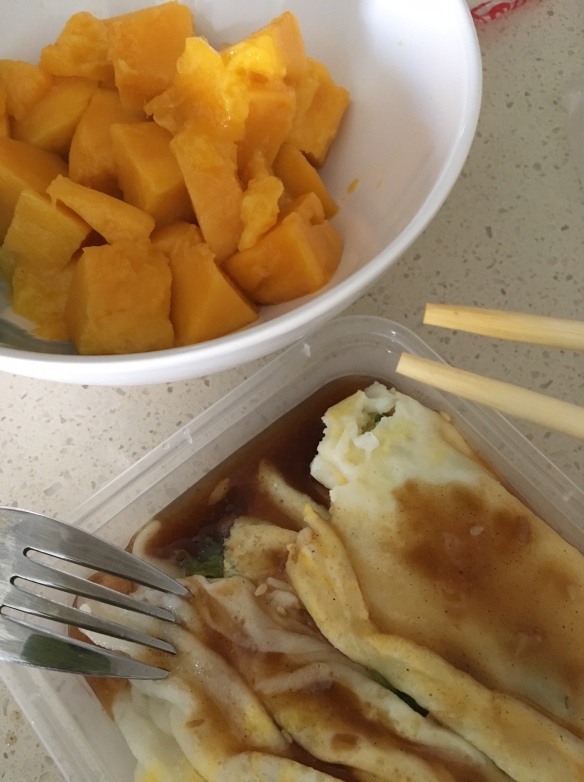
Delicious–fresh mango and a Cantonese breakfast food called chong fen (pork excluded, of course).
Risky business, making an order for food. Being vegetarian adds a serious layer of challenge to eating out.
Spying a toddler clad in split pants, Turtle points and laughs. “Hahaha! Mom, look! You can see his butt!”
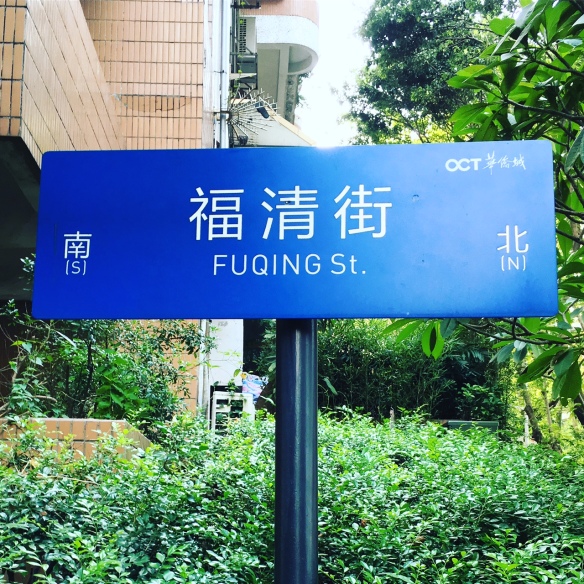
Sometimes you need to laugh a little.
People slap themselves while exercising. They also walk backwards.
There are eye exercises at school, wherein pupils shut and then rub their eyes in various patterns.
“That’s called the Beijing bikini,” says a coworker, as I point out the guy walking past our bus wearing his T-shirt rolled up so everyone can see his jiggling waist. This style of dress is common.
Style? It’s all over the place. From none to wow, there’s something for everyone.
Bentley. Porsche. Tesla. Maserati. Those with wealth flaunt it.

Cadillac is well represented in the area.
Yeah, it gets crowded. Mornings are less busy.
You could get mowed down in a crosswalk. Keep your eyes open–not just for cars, also for the jerk on the e-bike I mentioned earlier.
I’ve only seen one automobile accident. How is it possible, given the way these people drive? “There’s a rhythm to it,” says another coworker, describing the near-chaotic traffic. “It seems to be about occupying the space,” my coworker continues. “If you’re there first, you can have it, and if you turn and get partly there, then other drivers will yield to you.”
Amazing architecture.
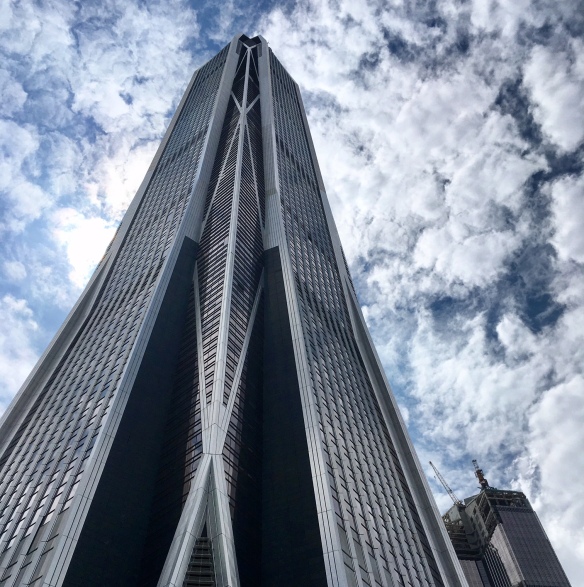
Newly completed, Ping An International Finance Center reaches 599 meters into the sky, making it the world’s fourth tallest building. It comes within about 10 meters of being the third tallest and is indeed impressive.

Outside the Chegongmio metro stop there are a number of impressive buildings.
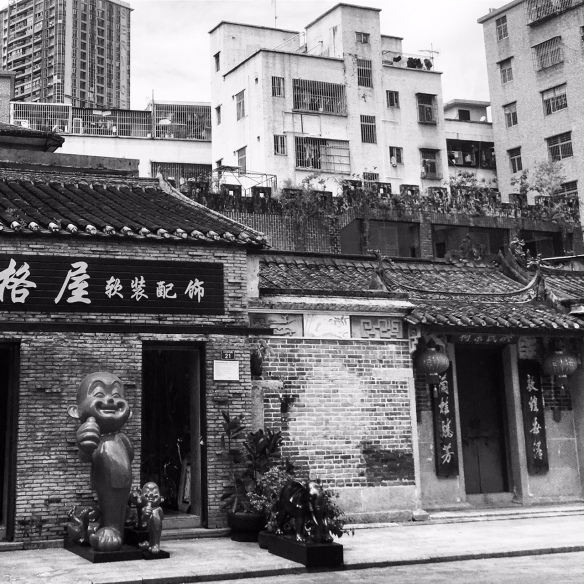
These buildings in Dafeng Oil Painting Village suggest the massive growth that’s taken place in the last thirty or forty years.
Mall interiors that defy logic. Why the devil isn’t there an escalator right here, with all the others, to get down a single floor?
Windows that get opened and left open for no reason, including while air conditioning is running.
Noise.
People often shout when they talk.
Shoddy workmanship.
Tropical vegetation. Lush.

That banyan tree blew my mind. The dude outside started examining it when I aimed my camera up.
Shopping for big items isn’t easy without a car.
Buying food is cheap, unless you opt for the high-end stuff. It’s possible to spend a lot if you’ve gotta have all the same stuff as you do at home. Also, cooking is a hassle when you can’t get all the same stuff as home (and you aren’t versed in Chinese foods).
Banks take forever. Under no circumstances change money at Bank of China. Just leave your cash at home (or swap it in HK at the airport’s forex) and use the friggin’ ATM. Jenia’s going to write an entire post about this.

22 kwai (if memory serves) buys a delightful Korean dish (kimchi fried rice), plus water and appetizers are free.
What a modern and efficient subway system. It actually is a pleasure to use.
It really is possible to eat out for less than it is to cook at home. Quality varies.
Ask any teacher and he or she will tell you: the first two weeks of classes are always pretty good. Students behave well as they learn the rules and expectations of a new teacher, and they’re normally not prone to testing the boundaries. The first weeks are, therefore, the easiest of the year. And what is it like in Shenzhen, China, after one week with Chinese eleventh graders?
Not bad.
The only aggravations are of a sort easily dismissed. They’re a result of the power in the office going out without warning periodically (I hope that grade book autosaved…oh, snot, it didn’t); the internet not always working properly, and a lack of wifi in the office. Oh, and there’s a bit of disorganization, which would probably have driven me nuts if I hadn’t been through worse before. For example, the English text books we are supposed to be using this term to help students firm up their language fundamentals only arrived yesterday, and further, it was unclear which classes were expected to use which books. As it turns out, grade 11 students will use a book called Interchange, while others at a higher level will use one called Know More English, the title of which seems a questionable play on words to me. One might have expected to know this stuff ahead of time, but ultimately, it’s not a big deal.
One fantastic thing about teaching where I am is that I get lots of prep periods. There is time to get organized, time to gather materials, and time to grade student work. There is actually enough time in the workday to get my work done. That’s huge. Last year, though I loved my job in Utah, I took work home every weekend. And not a little–hours worth of work. I didn’t have a spare moment at work, never mind actually being able to enjoy my entire weekend. Here, I have time again. It’s splendid.
I’ve found Chinese students to be more or less like students anywhere. There is a great deal of variation in capabilities–or rather desire, I suspect–between streams. Yep, students in this school are streamed according to ability. I have two classes which are higher level English learners, and one which is very low. The ones in the lower class tend to be unmotivated, as you might expect, so I have to wake sleepers and prod those who aren’t taking their work seriously. Oh, about sleepers–this is a boarding school where students are kept working until 9:00 at night, so that’s one reason they nod off. They’re legitimately tired, not just uninterested.
Yesterday left me with a smile on my face, for it was Teacher’s Day. As the day wore on, students brought me a box of apples, two big bouquets, chocolate, a couple of hand-written notes, and some fancy soap. In the evening, there was a banquet staged for all of us teachers, too, at some fancy restaurant, but it turned out my little ones weren’t welcome, so I skipped it. After all, who wants to go to a teacher’s day banquet where teachers’ families aren’t welcome?

Gifts for teacher’s day.

Traffic jam upon leaving. Note people walking in middle of road. The white Mazda is partly in the wrong lane.

Note the smiles and the flowers on the bus.
Another point of interest is the end of the school day at a boarding school on Friday. Since most of the English teachers live at a different location, we ride a bus to and from school. Yesterday, we sat in traffic–not even able to get out of the school gates–for almost 20 minutes because the students were going home. The kids rolled their carry-on sized luggage out the gates and along the sidewalk to a car sitting in the road waiting for them. It was a big of an exodus, and quite interesting to witness. Hopefully, though, our bus can make a quicker escape hereafter.
If things continue in this vein, I’ll be very pleased to be working in Shenzhen. Here’s hoping the first week is a harbinger of what is to come, not merely the honeymoon period.
Today my 4 year old son and I hiked a mountain. That is, we walked on a nicely paved road and granite stairs. Tang Lang Mountain overlooks our residence, and it’s been beckoning me since we arrived. Since Jenia won’t be talked into scaling its heights, such as they are, I dragged my boy along instead. Wowzers! We left at 9 in the morning and got back after noon. By then, my shirt was soaked and so were my shorts–soaked with sweat and nothing else!
Typhoon Hato caused, according to today’s headlines, no major damage when it came through yesterday. The threat of serious damage was enough to lead to school cancellations and the like. What we ended up with, however, was lots of broken tree branches and that is about it.

When we headed out on foot this morning, it was humid and there were many maintenance people out and about cleaning the sidewalks with straw brooms. They were sweeping leaves and other debris into piles along the sidewalks. It’s only a couple of blocks to Tang Lang Mountain, and there were lots of people cleaning up there, too. If you’ve worked in the UAE, you might have heard a couple of jokes about how dish washer and street sweeper aren’t appliances or what have you, but are actually careers–that might fit this area too. There were lots of guys (and ladies) out there sweeping the curving road along Tang Lang (which is, by the way, restricted to pedestrian traffic except for a few odd autos) with brooms. It’s got to be hard work in this heat.
Making the hike wasn’t easy. I’m told there are actually trails along Tang Lang, but I didn’t notice them. I did see sections of stairway, and those were too inviting to pass up. Going up the stairways is hard, I admit. Coming down them isn’t at all bad, however.
Since I had a 4 year old in tow, I had snacks and water for the trip. Those were magic–whenever things seemed too hard, a treat showed up, a pause along the way ensued and strength to continue was summoned forth.

We were rewarded for our climbing prowess (or rather, our hard fought tenacity) with splendid views out over Shenzhen and the bay. This is quite a place.


Should I mention the mosquitoes which enjoy the shadier places we found? Nah. Let’s just say the attraction was not mutual.
By the time we returned, dripping with sweat, Jenia was wondering if we were in fact coming back, and we were both ready to be off our tired feet. Traveling by foot with a four year old isn’t a particularly speedy proposition, and we’d also stopped at a shop to purchase a couple drinks on our way back, our water supply having dwindled. Notably, I recognized when the clerk said “Seven quid” in Chinese! It was a proud little moment! (I only just learned how to say seven yesterday, you see).
Days like this hot one really drive home how far we are from…well, home. Climbing the mountain provided a different view of the city, quite literally, and helped me feel like I am actually exploring the area. Tang Lang Mountain’s network of trails offer a little respite from the constant noises of city life. It’d be easy to forget that there are 15,000,000 souls not far off, were I not so unaccustomed to the area. It must be said that lush Shenzhen is nothing like rural Georgia, and even less similar to arid Utah. I look forward to my next hike.
Update: For more on Life in China, check out our new in 2018 blog, Our Traveling Zoo.
 Vantage Points